
Helping businesses find their hidden potential.
This profile article first appeared in the May 2026 issue of Dorset Life.
Working with owner-led companies, Beeson & Beeson reveal why success rarely depends on what’s missing, but on better understanding what’s already there.
‘It should just feel like you. But better. Like finally having a tailored suit that makes you feel a million dollars, rather than the one that made sense at the time but no longer fits.’
That, in Gareth Beeson’s words, is what good branding ought to do. He and his wife, Mel, have spent around 15 years doing just that through their Dorset-based partnership, Beeson & Beeson, applying the kind of thinking they once brought to Unilever, Barclays and Coca-Cola to a very different set of clients: the owner-led businesses and family companies who want that calibre of work, but delivered differently.
Because most of the time, Mel says, the problem isn’t the product. ‘Business owners with a great product will look at a competitor thinking, “I know that guy. My product is better, but people are talking to him, not me.” There’s a sort of embarrassment when you know something doesn’t fit. It’s a common challenge … and one that tends to get worse as the business grows, not better.’
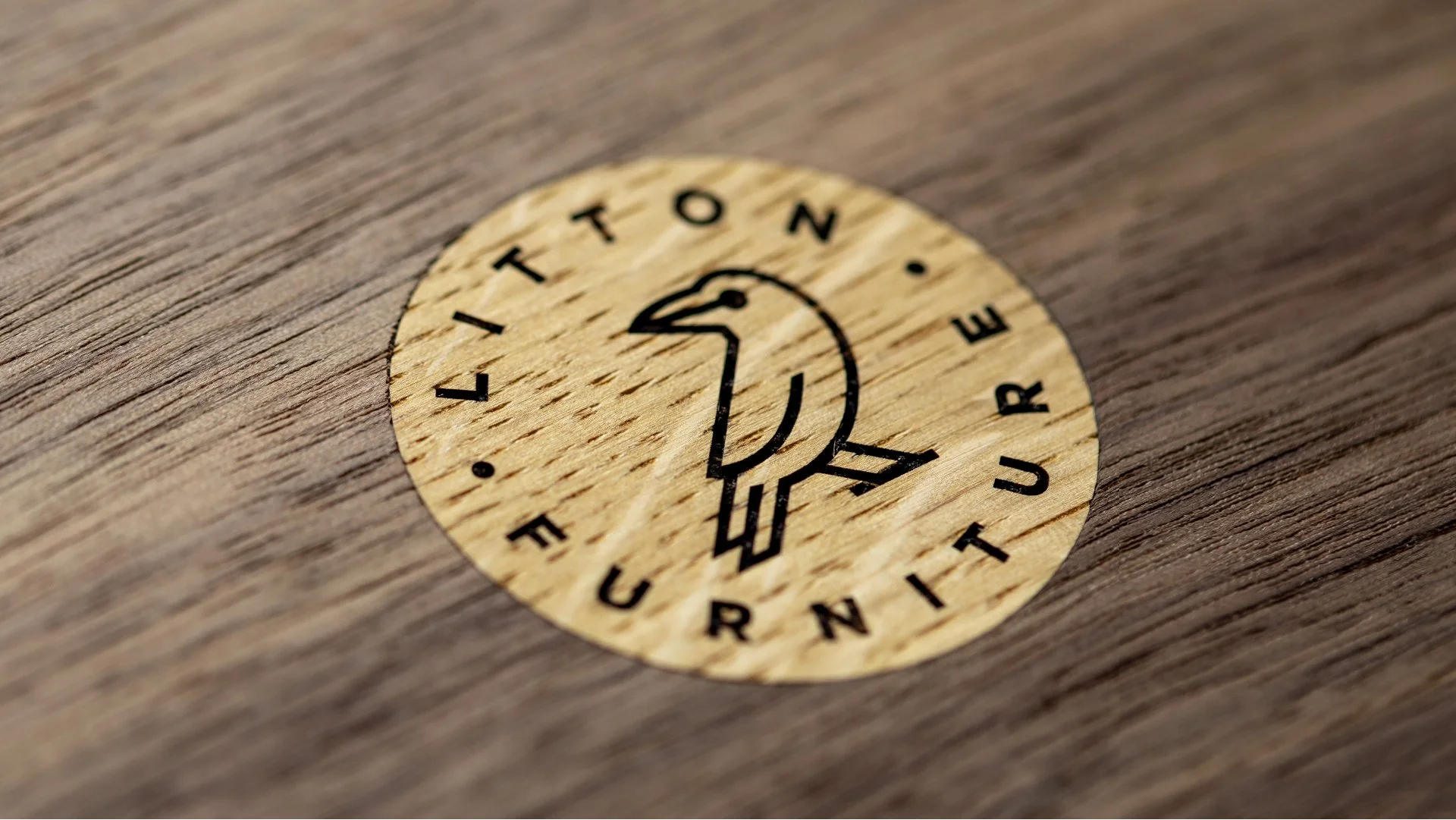
A brand mark designed by Beeson & Beeson for local furniture makers Litton.
Between them, Mel and Gareth spent more than two decades in London ‘agency land’, at the sharp end of the industry. Mel joined one of London’s best-known studios straight out of university and over the next 14 years worked her way up to deputy creative director, respnsible for brands including Unilever, Superdrug and Royal Mail.
‘I worked on everything from small, boutique jobs to major brands,’ she says. ‘You really learn how it all works. How to work with a client, understand their challenges, and deliver results.’
Gareth’s route was less direct. Growing up in Dorset, he resisted the expected migration to London, unable to see the appeal until a talk during his first year at college changed his mind.
‘This guy didn’t talk about design at all. He talked about ideas,’ he says. ‘Semiotics, the study of signs and symbols. And I just remember realising this isn’t about colouring in. This is something else entirely.’
He eventually did move to the city, working on United Biscuits, Jaffa Cakes and Barclays, then freelance with the teams behind BBC and Channel 4 idents and campaigns for countless other household names. He and Mel were at different agencies, but in overlapping worlds. ‘We were effectively in rival companies,’ Gareth says, ‘but not really. Everyone knew each other. It was a tight circle.’
That shared experience gave them both a clear view of how the industry works, and, just as importantly, where it can go wrong.
‘Sometimes clients are concerned that an agency has its own agenda,’ Gareth says. ‘Winning awards, getting it into a book, rather than helping the client achieve their goals. And having an understanding of how the industry works sometimes, we know that’s not an unreasonable worry.’
By the time they were married and had started a family, London no longer felt like the place to stay.
‘I don’t think either of us ever saw we’d be there forever,’ he says. They left in 2008, heading back to Dorset.
What followed was a period of transition. Mel worked remotely for the same agency while Gareth continued with freelance projects, eventually landing an agency role in Bristol on brands including Coca-Cola, Kraft and Cadbury. But with a growing young family, the reality of the commute quickly began to outweigh the benefits. Alongside that, the pair had begun taking on projects together.

Brand identity and packaging created for local gin producer Mounters 13.
The same problem
‘We picked up bits of work locally,’ Mel says. ‘Then we got the opportunity to work with Cambrook, who are probably our longest-standing client. They wanted a design partner that offered real value, while still providing the reassurance of experience. I couldn’t do it all by myself, so Gareth and I worked on it together and from there, it just kind of snowballed.’
What soon became Beeson & Beeson wasn’t a launch so much as a gradual shift. A creative partnership that solidified over time, shaped by the kinds of clients they attracted. And those clients, Gareth says, usually have something in common.
‘They’re usually founder-led or family businesses. Next generations taking over. Couples who’ve built something together. Heads of marketing carrying the weight of a brand on their own. People who’ve built something good, but know it’s not quite doing what it should.
‘They’re thinking, “I know something’s not right, but I don’t know what it is, and I don’t want to hand over a blank cheque to some big, intimidating agency who’s going to impose their own ideas.” But they also know they’re beyond the point where a local freelancer with a laptop is going to cut it. They need someone who can actually do the thinking.’
They’re also often clients who recognise something of themselves in how Mel and Gareth work. It’s a question they get asked a lot: how do you manage to work and live with your partner?
‘Honestly, it’s something that just seems to work for us,’ Mel says. ‘We’re both designers, but we share other parts of the business, playing to each other’s strengths. Having someone you trust completely to talk ideas through with, challenge thinking, and spark inspiration … that’s one of the real joys of working together. We don’t always agree – far from it! – but those conversations usually lead us to better ideas and more effective solutions.’
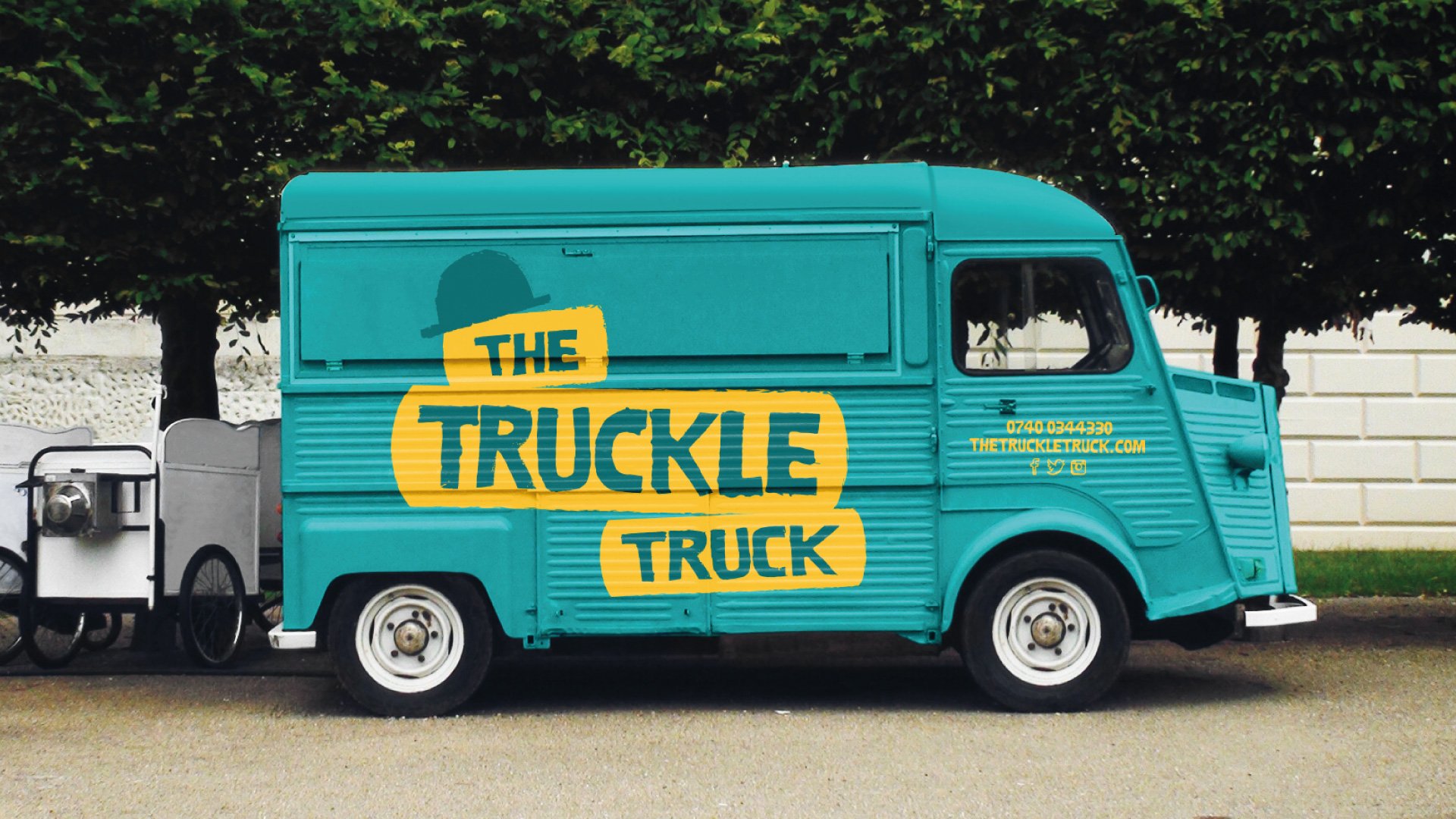
The Truckle Truck, a mobile cheesemongers designed by B&B is a familiar sight around North Dorset.
They’re also quick to point out they don’t work alone. Around them is a carefully chosen circle of collaborators: strategists, photographers, artworkers, copywriters, and other creative specialists they bring in as projects call for them. ‘It’s a way of working we really value,’ Gareth says. ‘Flexible, friendly and built on trust. It means our clients benefit from experienced people who genuinely care about doing great work.’
That’s the gap Beeson & Beeson have built their practice around. Senior-level, big-agency work, but delivered directly. Clients speak to the people doing the thinking.
‘We just get people round the table, quite literally our kitchen table, most of the time,’ Mel says. ‘We always start by understanding what’s actually going on.’
There’s no charge for that first conversation, and no expectation it leads anywhere. ‘We’ve had people come in and we’ve said, “actually, you don’t need us right now.” We tell them to go and focus on that other thing first,’ Gareth says.
If work does follow, it’s broken down into clear stages: what happens, how long it takes, what it costs, with space to pause or stop if needed. ‘It doesn’t have to be all or nothing,’ Mel says.
One of their longest-standing clients, Dorwest, illustrates how that process works in practice. A third-generation Dorset family business, Dorwest had grown steadily over decades with design handled in-house. When the next generation took over, they knew there was an opportunity, but weren’t sure how to unlock it.
‘They’d done a good job,’ Gareth says. ‘But they’d got as far as they could on their own.’
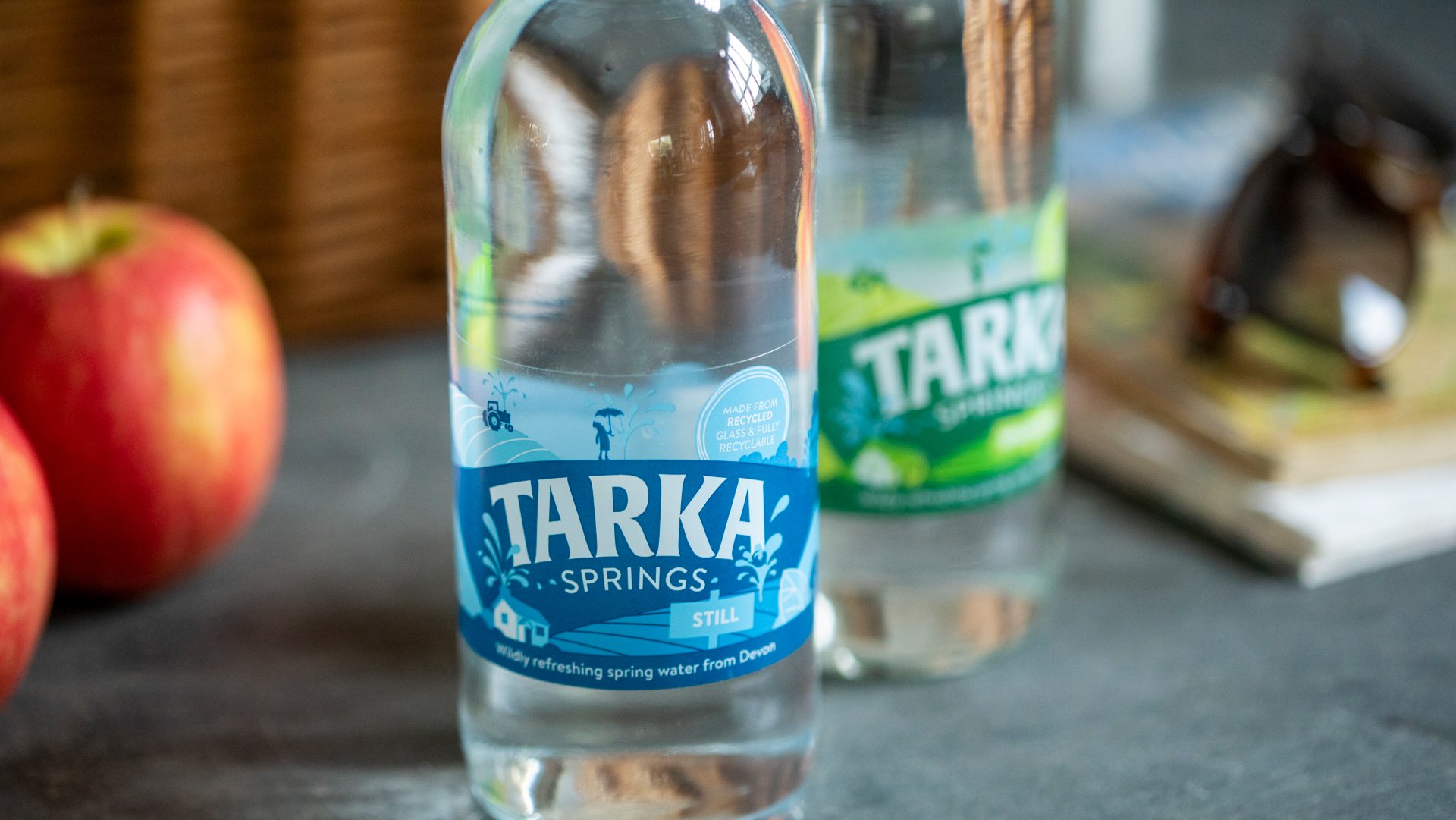
Branding created for Devon spring water company, Tarka.
To Crufts
Beeson & Beeson had to pitch against several much bigger agencies. The first conversation went well, and then the family mentioned that they’d had a stand at Crufts for more than 40 years and that it embodied what they did. The show started the next day: 24 hours’ notice.
‘I just thought I’d make it work,’ Gareth says. ‘I arrived at eight o’clock the next morning and immersed myself in Crufts. When I met them on the stand, they were completely bowled over. Of the four agencies they’d spoken to, no one else had bothered.’
Before proposing a single design change, Beeson & Beeson set about understanding the business properly, including its customers. ‘They had thousands of loyalty club customers, but they’d never really asked them about the brand,’ Gareth says. So Beeson & Beeson did: surveys, conversations with staff and family, cups of tea with the previous generation. ‘Finding out what mattered to them, and why they’d done things the way they had.’
It’s the kind of approach Gareth says is typical of senior agency work, and conspicuously absent from the freelance end of the market. ‘A smaller designer wouldn’t have the experience to question things. But we’d ask, why is it done that way? And sometimes, as with Dorwest’s print production, just asking the right questions saved them money overnight.’
Only then did design enter the conversation. ‘Quite often, it’s about extracting what’s already there,’ Mel says. ‘The knowledge is in the business. It just needs bringing through.’
That idea – that most businesses already have what they need, but struggle to express it – sits at the heart of how they work.
‘People are making brand decisions all the time,’ Gareth says. ‘Where they source things, how they answer the telephone. They just don’t realise that’s all branding. It’s always there, but it’s often unstructured, unarticulated. If you’re running around doing everything as a small team, it’s hard to see it clearly. Sometimes you just need an objective pair of eyes.’

Literature designed for herbal pet care company Dorwest.
Making sense
There’s no ‘Beeson & Beeson look’. Their portfolio is as varied as the businesses they work with. What’s consistent is the process: helping a business understand what it already is, and then how to communicate it properly.
‘Once you’ve got the idea, you can apply it to every part of the business,’ Mel says. ‘It’s often simple changes that just make the shoulders drop with relief. Knowing someone has made sense of everything, and given them a brand they’re proud of.’
The process, clients often find, is liberating and less traumatic than anticipated. Not always a reinvention, but a sense that things finally fit. That what a business is doing, and how it appears to the outside world, are aligned. Or, as Gareth puts it, something that simply feels right when you put it on.
If any of this sounds familiar – the sense that something isn’t quite right, that the brand no longer fits the business you’ve become, Beeson & Beeson would be happy to have the conversation. There’s no charge for a first chat, and no expectation it leads anywhere. Sometimes a cup of tea at the kitchen table is enough to bring the problem into focus.
And if you’re not sure whether your brand is holding you back in the first place, their short online quiz, ‘Is Your Brand Slowing You Down?’, is a useful place to start:
beesonandbeeson.com